

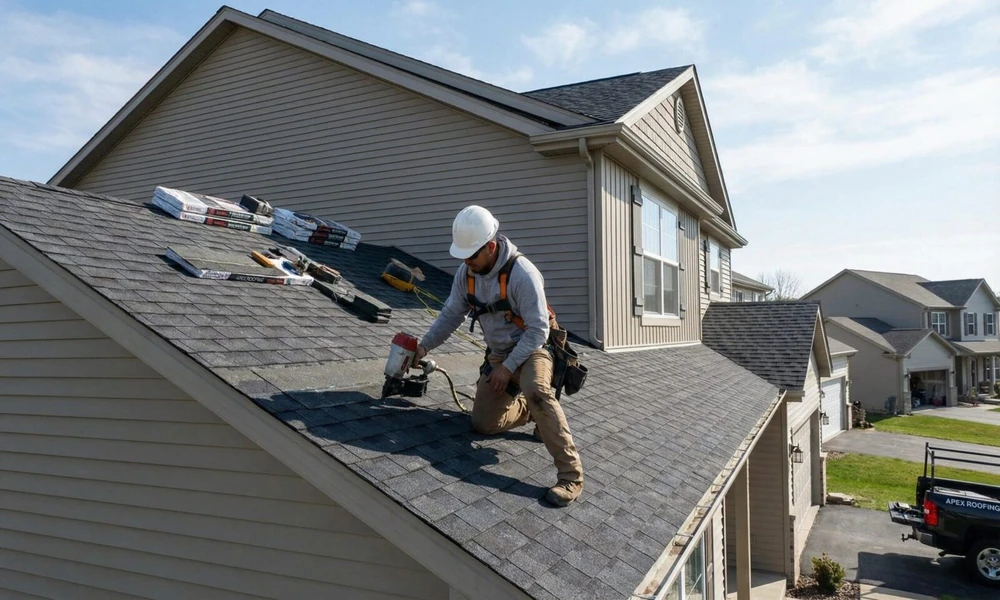
Roofing choices in Idaho’s Treasure Valley involve a different balance than they do in consistently warm climates. Boise and nearby communities experience winter snow, freezing temperatures, hot and dry summers, and large seasonal temperature swings. The National Weather Service recorded a 104°F high in Boise during July 2026, while winter design criteria used locally reach far below summer conditions. A roof therefore needs to tolerate both thermal movement and winter loading without relying on one performance metric alone. The National Weather Service Boise climate archive provides long-term temperature, precipitation, and snowfall records for the area.
Homeowners comparing options through Green Idaho Roofing can choose among roof repair and replacement, Malarkey shingle systems, architectural shingle packages, Versico membrane roofing, and standing seam metal, along with soffit, fascia, siding, and window work. The company identifies its service area as the greater Treasure Valley, including Boise, North Boise, Meridian, Middleton, Caldwell, Nampa, Star, Kuna, and Eagle. That coverage is useful because the best material choice can vary by roof pitch, budget, exposure, and how long the owner expects to keep the property.
Premium Shingles Versus Budget Architectural Shingles
The most direct comparison for many Treasure Valley houses is between a higher-performance asphalt system and a more economical architectural shingle package.
Upfront cost versus enhanced performance. Standard architectural shingles generally cost less at installation. Premium polymer-modified shingles increase the material price, but may provide stronger impact resistance, greater flexibility, and improved resistance to temperature-related stress.
Green Idaho Roofing’s Go-Green system uses Malarkey products, while its Save-Green option uses architectural shingles positioned as a lower-cost alternative. The company’s published comparison identifies Malarkey Vista as a Class 4 impact-rated option and its Save-Green TAMKO Titan XT package as Class 3.
Budget priority versus ownership horizon. For someone planning to sell within several years, paying for the highest available specification may offer less practical value. An owner expecting to remain in the same house for decades may care more about durability, impact rating, and how the material handles repeated thermal cycling.
Conventional asphalt versus modified asphalt. Polymer-modified asphalt is designed to stay more flexible than traditional formulations. That characteristic is relevant where roofing repeatedly moves between summer heat and freezing winter conditions.
Neither product eliminates the need for correct ventilation, flashing, underlayment, fastening, and deck preparation. A premium shingle installed over a deficient assembly can still underperform.
| Comparison point | Architectural shingles | Premium modified shingles | Standing seam metal | Low-slope membrane |
|---|---|---|---|---|
| Initial investment | Lower | Moderate to higher | Highest in many homes | Varies by assembly |
| Snow shedding | Moderate | Moderate | High on steeper slopes | Low, snow remains in place |
| Impact performance | Product dependent | Often higher rated | Strong structurally, cosmetic dents possible | Product and substrate dependent |
| Thermal movement | Moderate | Designed for improved flexibility | Significant and must be accommodated | Managed through membrane detailing |
| Typical application | Sloped homes | Sloped homes | Sloped homes and architectural projects | Flat or low-slope areas |
| Maintenance focus | Shingles and flashing | Shingles and flashing | Seams, clips, penetrations | Seams, drains, penetrations |
Asphalt Versus Standing Seam Metal
Standing seam changes the cost equation substantially.
Lower purchase price versus longer service potential. Asphalt generally wins on initial cost. Standing seam metal often requires more capital upfront but can offer a substantially longer service life when the roof design and installation are appropriate.
Snow retention versus snow shedding. Asphalt’s textured surface tends to hold snow more readily. Smooth metal can allow accumulated snow to release suddenly once temperature and friction conditions change.
That can be advantageous because snow leaves the roof, but it creates a different concern near entrances, walkways, decks, parked vehicles, and lower roof sections. Snow guards or other retention strategies may be appropriate where uncontrolled sliding creates a hazard.
Boise’s adopted residential design criteria make snow a structural consideration, not merely a maintenance issue. The city’s published criteria specify a 20 psf ground snow load and require the design roof load to be no less than a uniform 25 psf snow load.
Minimal surface maintenance versus more complex detailing. Metal does not have shingle granules to lose and generally does not need the same replacement cycle as asphalt. It does, however, expand and contract considerably. Clips, seams, flashings, penetrations, and transitions must accommodate that movement.
A metal roof that is restrained incorrectly can develop stressed connections or distorted panels even though the material itself remains durable.
Impact Resistance Versus Cosmetic Appearance
Idaho homeowners sometimes treat impact rating and appearance as the same question, but they are not.
Functional damage versus cosmetic damage. A roof can remain watertight while showing dents or surface marks. Metal is a good example. A hail event may leave visible dimples without puncturing panels or opening seams.
Asphalt responds differently. Severe impacts can fracture the mat, dislodge granules, or weaken the shingle in ways that may not be obvious from ground level.
Higher rating versus guaranteed survival. Impact classifications describe performance under standardized testing. They do not mean that a roof is immune to every hailstone, branch, or windborne object.
Premium impact-resistant shingles may reduce vulnerability, but roof pitch, age, temperature during the event, substrate condition, and impact size still influence actual damage.
This distinction matters when comparing a lower-cost roof with a premium system. The added expense is buying improved resistance and potentially longer performance, not immunity from Idaho weather.
Steep-Slope Roofing Versus Membrane Roofing
Versico membrane roofing belongs in a different category because it is typically used where slope is too low for conventional shingle drainage.
Water shedding versus waterproofing. Shingles primarily shed water downhill. They rely on slope and overlapping courses.
Low-slope membranes function more like continuous waterproofing surfaces. TPO and similar single-ply membranes use welded seams to create a continuous barrier, which is better suited to areas where water drains more slowly.
Snow sliding versus snow accumulation. A membrane roof generally retains snow rather than releasing it rapidly. That places greater emphasis on structural design and drainage once melting begins.
Simple field area versus critical details. Large membrane areas can appear straightforward, but penetrations, drains, curbs, parapets, seams, and transitions become particularly important. A failure at one detail can allow water beneath a broad membrane area.
For houses with both pitched and low-slope sections, using two roofing systems can be more appropriate than forcing one material across every surface.
Low Price Versus Complete Roof Scope
Material selection is only one part of total project cost.
Shingle price versus roof-system price. A lower-cost shingle does not automatically produce a lower-quality roof if decking, underlayment, ventilation, flashing, starter material, ridge components, and installation remain sound.
Conversely, an expensive covering does not compensate for deteriorated fascia, damaged soffits, inadequate ventilation, or poor flashing.
That matters in the Treasure Valley because roof edges and attic conditions are part of winter performance. Soffit and fascia deterioration can affect ventilation openings and roof-edge integrity. If repairs are already needed, addressing them during replacement may be more efficient than treating each component as a separate future project.
Simple Replacement Versus Permit and Code Compliance
A reroof is still regulated construction.
The City of Boise lists reroofing among residential projects requiring a building permit. Its permit materials cover replacement or repair of roofing and note that structural modifications, such as replacing roof trusses, require a different level of review. Boise also limits roofing to a maximum of two layers and imposes additional material requirements in designated Wildland Urban Interface areas. The city’s residential construction guidance and reroof application outline those requirements.
Boise rules versus Treasure Valley rules. Green Idaho Roofing’s service area crosses several jurisdictions. Meridian, for example, separately administers permits and currently identifies the 2018 IRC among its adopted structural codes. Nampa also requires permits for residential improvements and remodels. Property owners should therefore confirm requirements with the municipality governing the actual address rather than assuming Boise procedures apply across the valley.
The side-by-side comparison ultimately comes down to priorities. Architectural shingles favor lower initial spending. Polymer-modified shingles add performance features at a higher cost. Standing seam metal trades a large initial investment for long service potential and efficient snow shedding. Membranes solve drainage problems on roof areas where shingles are inappropriate.
For Treasure Valley homes, the strongest choice is the system that fits the roof geometry, local snow requirements, summer heat exposure, expected ownership period, maintenance tolerance, and project budget. Comparing those factors together provides a more useful answer than asking which roofing material is simply “best.”
