

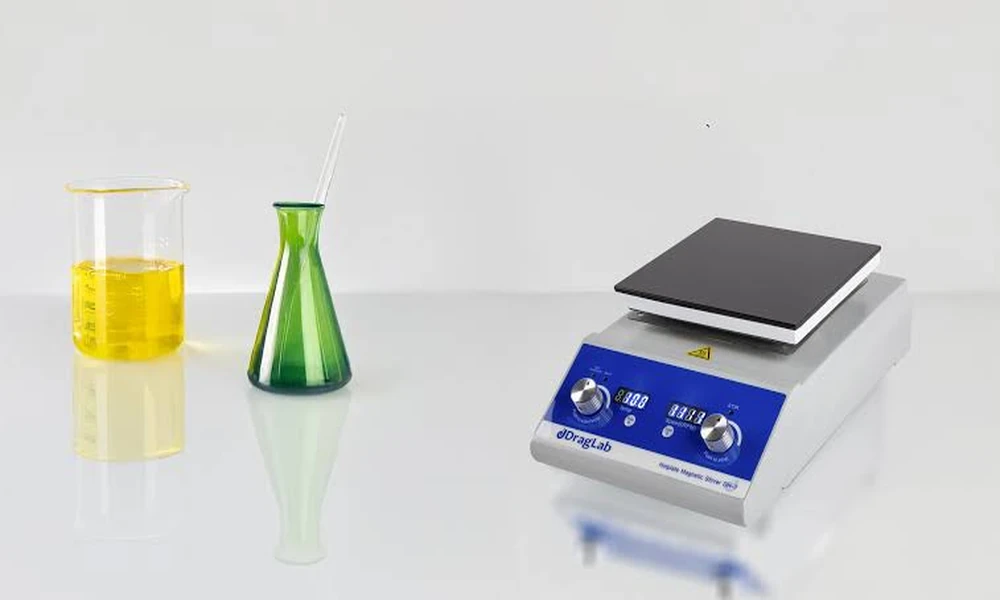
Walk into almost any teaching lab, quality control room or research bench and you will find a magnetic stirrer hot plate humming away somewhere. It dissolves salts, prepares media, keeps suspensions even and warms solutions to a set temperature, all without a motor shaft dipping into the liquid. Because it is so common, it is also one of the easiest pieces of equipment to buy badly.
A unit that suits a school chemistry room may struggle with viscous samples in a pharmaceutical lab, and a model built for heavy-duty heating may be overkill for buffer preparation. Matching the instrument to the work you actually do saves money and avoids frustration later.
How Do Magnetic Stirrers Work Without Touching the Liquid?
Magnetic stirrers use a rotating magnet, or a set of electromagnetic coils, hidden beneath the top plate. A small stir bar, usually a magnet coated in PTFE, sits in the vessel. As the magnetic field turns underneath, the bar follows it and spins, creating a vortex that mixes the contents.
Since nothing passes through the lid, the vessel can stay covered, and there are no seals or shafts to clean or contaminate. When a heating element is built in under the top plate, you get a hot plate and magnetic stirrer in one unit, which is why the combined format has become the default on most benches.
The stir bar is part of the system. Its length, shape and magnetic strength should suit the vessel. A short bar in a wide beaker will not move the whole volume, while an oversized bar in a narrow flask can rattle and break the glass.
What Specifications Matter Most When Comparing Models?
Start with three numbers: stirring capacity, speed range and maximum temperature.
Stirring capacity is usually given as a maximum volume of water. Thicker liquids need far more torque, so if you work with gels, syrups or slurries, look for a stronger drive and treat the stated volume as an upper limit for water only. Speed range is commonly shown in revolutions per minute; a low, stable minimum speed is as useful as a high top speed when you are mixing delicate samples.
Maximum plate temperature is often several hundred degrees Celsius, but remember that the plate surface runs much hotter than the liquid above it. If your method specifies a liquid temperature, choose a unit that accepts an external temperature probe so the controller regulates the sample, not the plate.
Other details worth checking include digital or analogue control, a display of actual versus set values, timer functions, and whether the unit carries a separate safety circuit that limits the plate temperature if the main controller fails.
Is a Ceramic or Aluminium Top Better for a Magnetic Mixer Hot Plate?
The top plate decides how heat reaches your vessel and how well the surface survives spills.
Ceramic or glass-ceramic tops resist many acids and solvents and are easy to wipe clean, which makes them popular in chemistry labs. They can, however, crack under sudden temperature shock, such as a cold spill on a hot surface, and they may heat less evenly across their area.
Aluminium tops spread heat quickly and evenly, which helps when you use heating blocks for round-bottomed flasks or vials. They are more vulnerable to corrosive chemicals, so many come with a coating. Stainless steel tops sit somewhere between the two.
If your magnetic mixer hot plate will mostly handle aqueous buffers and media, either material works. For aggressive reagents, a chemically resistant top is the safer bet; for precise, uniform heating of several small vessels, aluminium with a block is often preferable.
Why Does Stir Bar Decoupling Happen and How Can You Prevent It?
Decoupling is when the stir bar loses its grip on the magnetic field and starts to jump or wobble instead of spinning smoothly. It usually happens when the speed is raised too quickly, when the liquid is thick, or when the vessel sits off-centre or too high above the plate.
The fix is straightforward. Centre the vessel, choose a flat-bottomed container where possible, and increase speed gradually. A stronger drive magnet and a correctly sized bar make a noticeable difference with viscous samples. Some modern controllers detect decoupling automatically and restart the bar at a lower speed.
What Safety Checks Should Every Lab Follow?
Laboratory safety guidance from university health and safety offices tends to repeat the same points, and they are worth taking seriously:
- Set the safety temperature limit well below the flash point of any solvent you are heating.
- Never heat a sealed vessel; leave room for expansion and keep oil baths less than half full.
- Monitor the liquid with a separate calibrated thermometer rather than trusting the plate display alone.
- Keep paper, wash bottles and flammable waste away from the plate, and secure cables.
- Unplug the unit when it is not in use, as an older or faulty controller can fail in the on position.
Flammable solvents call for extra caution. Even a plate without an open flame can ignite vapours if its surface is hot enough, so work in a fume hood and choose a model with a sealed or spark-free design where solvents are routine.
Where Should a Hot Plate Stirrer Sit in a Shared Lab?
Placement is easy to overlook. A hot plate stirrer throws off heat and generates a moving magnetic field, and both can upset sensitive instruments nearby. A lab analytical balance is the classic example: warm air rising from a hot plate creates convection currents around the weighing pan, and stray magnetic fields can nudge readings on high-resolution weighing cells. Keep the two on separate benches, or at least well apart, and weigh reagents before the stirrer starts heating.
Give the stirrer a stable, level surface away from shelf edges, with space around it for ventilation and quick access to the controls.
How Can You Match a Stirrer to Your Daily Workload?
Think about the volumes, viscosities and temperatures you handle in a typical week, then choose capacity with some headroom rather than the largest model on the shelf. Labs that run many small samples in parallel may find multi-position stirrers more efficient than several single units. Look for an external probe socket if temperature accuracy matters, a top material that suits your reagents, and a separate over-temperature cut-out for safety. A well-chosen unit, kept clean and checked regularly, can serve a busy bench reliably for many years.
